Table of content

Use this mid parental height calculator to estimate a child’s expected adult height range from the parents’ heights. Choose cm or feet/inches, pick boy or girl, then get the mid-parental height estimate plus a typical range you can compare with growth charts.
If you’re ready to get a quick estimate, just enter the two parents’ heights and pick whether the child is a boy or a girl.
Enter the father’s height and mother’s height.
Get the results immediately.
Read the estimate and the suggested range below the tool.
That’s it—if you plan to compare results later, stick to the same unit and measure heights the same way each time (no shoes, standing tall).
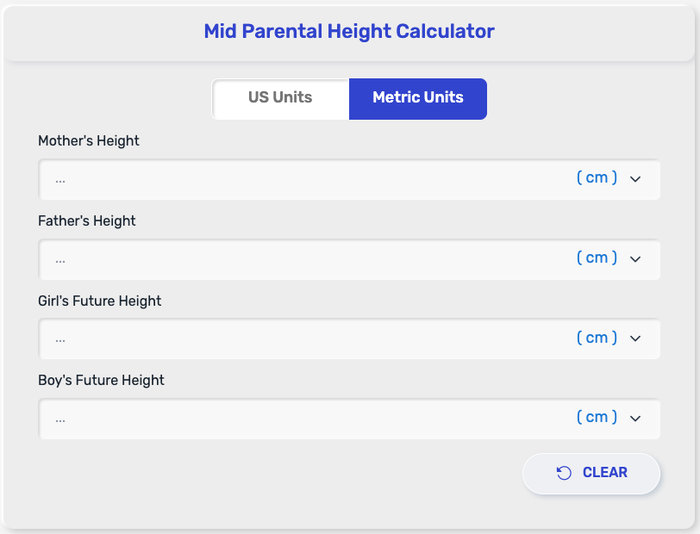
This tool estimates a child’s expected adult height based on the heights of both parents. You’ll get a single mid-parental height number (the “best-guess” midpoint) and, in most versions of this method, a reasonable range around it so you’re not stuck with just one exact figure.
Here’s what it can calculate:
Mid-parental height estimate for boys using the standard parent-height formula for a male child.
Mid-parental height estimate for girls using the standard parent-height formula for a female child.
Results in centimeters or feet/inches, depending on the unit option you choose.
A predicted adult-height range around the estimate (if shown on the results screen), giving you an upper and lower value to compare rather than one strict number.
It’s designed for quick parent-based estimation—useful for a simple expectation check, not as a guaranteed final height.
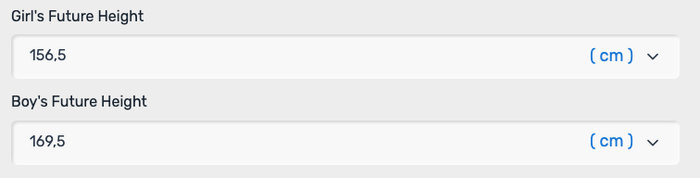
The results update immediately as you type—so the “Girl’s Future Height” and “Boy’s Future Height” fields are calculated in real time from the mother’s and father’s heights. No extra steps, no calculate button.
What the “Girl’s Future Height” result means. This is the mid-parental height estimate for a girl, based only on the two parent heights you entered. It’s a midpoint estimate, not a fixed outcome.
What the “Boy’s Future Height” result means. This is the mid-parental height estimate for a boy, using the same parent heights. Because the formula uses a different adjustment for boys vs. girls, the two results will be different.
Why do the numbers change while you type? Each time you edit a height value or switch between US Units and Metric Units, the calculator:
Converts values into a single internal unit,
Applies the mid-parental formula for girl and boy,
Then converts back to the unit you selected for display.
You may notice the result shift by 1 cm or 0.5–1 inch after changing units or editing the last digit. That’s normal and comes from unit conversion and rounding for clean display.
This calculator uses the standard mid-parental height method. Enter the parents’ heights, then it outputs two estimates right away: one for a girl and one for a boy.
Metric: ((father + mother) − 13 cm) × ½
US units: ((father + mother) − 5 in) × ½
Metric: ((father + mother) + 13 cm) × ½
US units: ((father + mother) + 5 in) × ½
Note: If you enter heights in ft/in, the calculator converts them behind the scenes, runs the formula, then converts the result back for display.
A mid parental height result is usually shown as a middle estimate plus a range, not just one final number. That’s because real-life growth isn’t perfectly predictable. Even with the same parents, kids can end up taller or shorter than the midpoint for lots of normal reasons—genetics from extended family, puberty timing, measurement differences, and overall health.
Many calculators add a “buffer” around the mid-parental height to show a realistic window where adult height often lands. A common approach is about ±8.5 cm (±3.3 in) around the midpoint.
So if the mid-parental height estimate is 170 cm, a displayed range might look like 161.5–178.5 cm.
The range isn’t a promise. It’s a way to avoid treating the midpoint like a fixed destination.
Within range: Pretty typical outcome. It suggests the child’s adult height could reasonably land somewhere in that window.
A bit outside range: Still can be normal. Some kids end up outside the range just because of natural variation in genetics and growth timing.
Far outside range (especially with a growth pattern that changes a lot over time): That’s when people usually stop relying on a simple parent-based estimate and look at growth charts, family patterns, and—if needed—medical context.
A key detail: one height measurement doesn’t say much by itself. A growth trend over time is usually more meaningful than a single point.
If two sites give slightly different ranges, it usually isn’t a red flag—most of the time it’s just different assumptions and rounding, not a major disagreement about the idea.
Most kids grow in their own pattern, but there are a few health-related things that can slow growth over time. This doesn’t mean something is wrong—just that growth can reflect what’s going on in the body.
Some examples include:
Long-term health conditions that affect appetite, digestion, or energy levels (so the body has less fuel for growth)
Hormone-related issues (like thyroid problems or growth hormone conditions) that can change growth speed
Nutrient gaps over a long period, especially if a child isn’t getting enough overall calories, protein, iron, calcium, or vitamin D
A useful way to spot a potential issue is to look at the growth trend, not a single height. If a child:
drops across growth percentiles over time,
grows much more slowly than before,
or seems to fall far behind their usual pattern,
…it’s a good idea to check in with a pediatrician or clinician. They can review growth charts, family height patterns, and—if needed—run simple checks to rule out common causes.
Mid parental height is the “parents-only” option. Other methods bring in the child’s current growth data (and sometimes bone age), so they can be more personalized—especially as a child gets older.
|
Method |
What it uses |
What you get |
What it’s best for |
|
Mid parental height (Target height) |
Mother + father height, child’s sex |
A midpoint estimate + a common target range |
A fast genetics-based estimate, even when you don’t have recent measurements |
|
Growth chart projection (percentile tracking) |
Child’s age + height over time plotted on CDC/WHO charts |
“Projected adult height” by following the same percentile curve |
Seeing whether growth is tracking steadily over time (trend-based) |
|
Khamis–Roche |
Parents’ heights + child’s current height + weight + age |
Predicted adult height (no X-ray) |
School-age kids when you have current measurements (more individualized than parents-only) |
|
Bone age methods (Bayley–Pinneau, TW, RWT, BoneXpert, etc.) |
X-ray bone age + height (and sometimes other measures) |
Predicted adult height, often with confidence limits |
Clinical settings, puberty timing questions, growth concerns |
CDC notes growth charts are tracking tools and aren’t meant to be the only diagnostic instrument.
A recent review paper also describes “target height” (mid-parental height adjusted for sex) as something typically compared against a growth-chart-based projected height.
What it uses: just the parents’ heights (plus a sex adjustment).
What it gives: a midpoint estimate and often a “target height range.”
A commonly cited “target range” is ±8.5 cm around the mid-parental target height (a wide, realistic window rather than one exact number).
Strengths
Works even if you don’t know the child’s current height/weight.
Stable baseline for family genetics.
Limits
Doesn’t react to the child’s current growth pattern (early/late puberty, recent growth spurts, long-term illness, etc.).
What it uses: the child’s measured height across time on CDC/WHO growth charts.
What it gives: a projected adult height by extending the same percentile curve.
CDC explains growth charts are percentile curves used to track growth and support an overall clinical picture (not a stand-alone verdict).
The 2024 paper on target height also describes projected height as extrapolating a child’s current percentile to adult age.
Strengths
Great for spotting whether growth is staying on a steady track.
Uses real measurements, not just genetics.
Limits: Less reliable during periods where percentiles can shift (often around puberty timing differences).
What it uses: parents’ heights + the child’s current height, weight, and age.
What it gives: a predicted adult height estimate without a bone-age X-ray.
This method is widely discussed in pediatric growth prediction research, often grouped among established prediction approaches alongside bone-age-based methods.
Strengths: Uses the child’s current size (so it adapts more than mid parental height alone).
Limits: Needs accurate, current measurements and works best in the age ranges it was designed for.
What it uses: an X-ray-based bone age plus height (and method-specific tables/models).
What it gives: predicted adult height—sometimes with wide confidence limits, especially earlier in puberty.
Research notes Bayley–Pinneau predictions can overestimate adult height in children with advanced bone age and underestimate in delayed bone age (so maturity timing really matters).
A BoneXpert chapter reviews several bone-age-based adult height prediction methods, including Bayley–Pinneau, and discusses how bone age assessment approach influences prediction.
Strengths: Useful when puberty timing or maturation is a big part of the question.
Limits: Requires imaging and expert interpretation; accuracy can vary depending on bone age method and timing.
Centers for Disease Control and Prevention (CDC) – CDC Growth Charts
https://www.cdc.gov/growthcharts/cdc-growth-charts.htm
Centers for Disease Control and Prevention (CDC) – Growth Charts
https://www.cdc.gov/growthcharts/index.htm
Centers for Disease Control and Prevention (CDC) – WHO Growth Charts (0–59 months)
https://www.cdc.gov/growthcharts/who-growth-charts.htm
Zeevi D, et al. (2024) – Accurate Prediction of Children’s Target Height from Their Mid-Parental Height (PMC)
https://pmc.ncbi.nlm.nih.gov/articles/PMC11352326/
Children’s Mercy Kansas City – Evaluating Growth Failure (mid-parental height + target height range mention)
https://www.childrensmercy.org/health-care-providers/pediatrician-guides/endocrinology/growth-failure/
Khamis HJ, Roche AF. (1994) – Predicting adult stature without using skeletal age (PubMed)
https://pubmed.ncbi.nlm.nih.gov/7936860/
Cavallo F, et al. (2021) – Evaluation of Bone Age in Children: A Mini-Review (PMC)
https://pmc.ncbi.nlm.nih.gov/articles/PMC7994346/
Thodberg HH, et al. – Adult Height Prediction Models (BoneXpert PDF; reviews Bayley–Pinneau and others)
https://bonexpert.com/wp-content/uploads/2020/01/Paper12-Growth-Ver7nice.pdf
Badawi N, et al. (2021) – Validity of the Bayley–Pinneau method (notes over/underestimation with advanced/delayed bone age)
https://journals.viamedica.pl/endokrynologia_polska/article/viewFile/75432/63758
It gives a rough midpoint estimate based on parents’ heights. Real adult height can still land above or below the result.
The formula uses different adjustments for girls and boys, so the calculator displays both estimates from the same parent heights.
No. The results update instantly as you type or change units.
The calculator converts units and rounds the display value. Small differences are normal after conversion.
Use measured height without shoes for cleaner results.
Not for this method. It’s based on the parents’ heights and the child’s sex, not the child’s current height.
Yes. Even with the same parents, siblings can grow to different adult heights.
Puberty timing can shift the growth pattern, and it can affect where a child ends up compared with the midpoint estimate.
If growth seems unusually slow or fast over time, or if there are other health concerns, a pediatrician can check growth patterns with medical context.
midparentalheightcalculator.com is a simple online tool designed to help estimate a child’s potential adult height using the widely known mid-parental height formula. By entering the heights of the parents and selecting the child’s gender, users can quickly receive an estimated height range based on commonly used growth prediction methods.
Our goal is to provide an easy-to-use and accessible calculator for parents, students, and anyone interested in understanding basic height prediction concepts. The tool is built to deliver quick results without requiring sign-ups or complex steps, making height estimation straightforward and convenient.
midparentalheightcalculator.com was created and maintained with contributions from a small team of developers and contributors who focus on building simple, reliable online calculation tools for everyday use. While this calculator uses commonly referenced formulas in pediatric growth estimation, the results should be considered approximate and for informational purposes only. Actual adult height can vary due to genetics, nutrition, health conditions, and environmental factors. For medical guidance or professional evaluation, consulting a healthcare professional is recommended.
We are committed to providing a simple, reliable, and easy-to-use height estimation tool while respecting user privacy and maintaining transparency.
midparentalheightcalculator.com does not require account registration or personally identifiable information. Any values entered into the calculator, such as parental heights or child gender, are used only to generate instant results and are not stored, shared, or sold.
This calculator uses the commonly known mid-parental height formula to provide an estimated adult height range for informational purposes only. Results are approximate and may vary significantly depending on genetics, nutrition, health conditions, hormonal factors, and other developmental influences. This tool should not be considered medical advice or a substitute for professional evaluation.
By using this tool, you agree to use it responsibly and understand that midparentalheightcalculator.com is not liable for decisions made solely based on the estimated results provided by the calculator.
We may update this Policy from time to time to reflect improvements to the tool or changes in legal and regulatory requirements. Any updates will be posted on this page to ensure continued transparency.